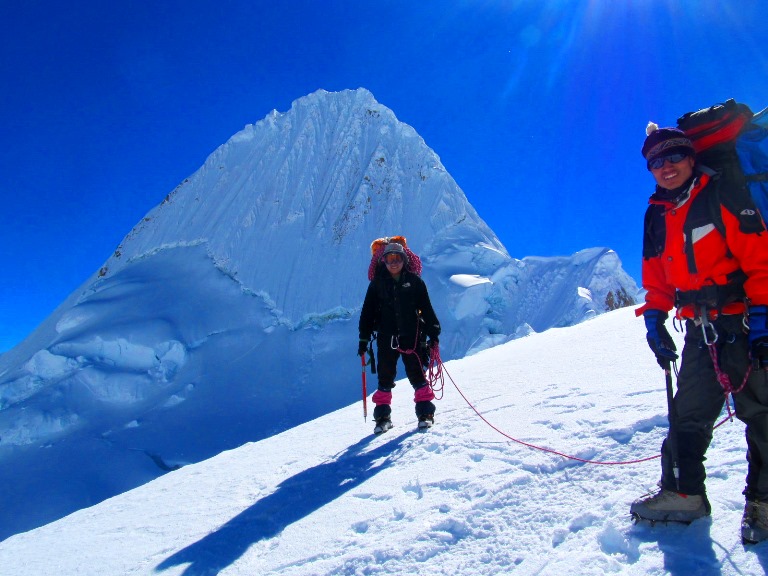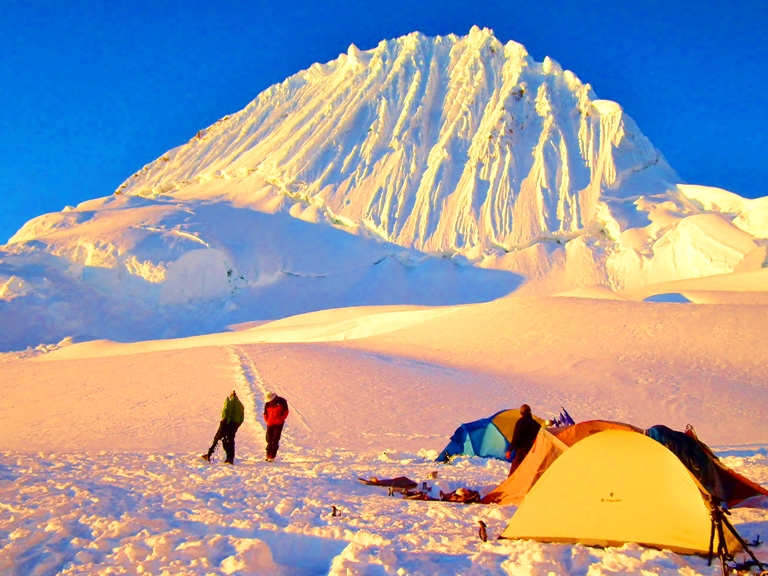

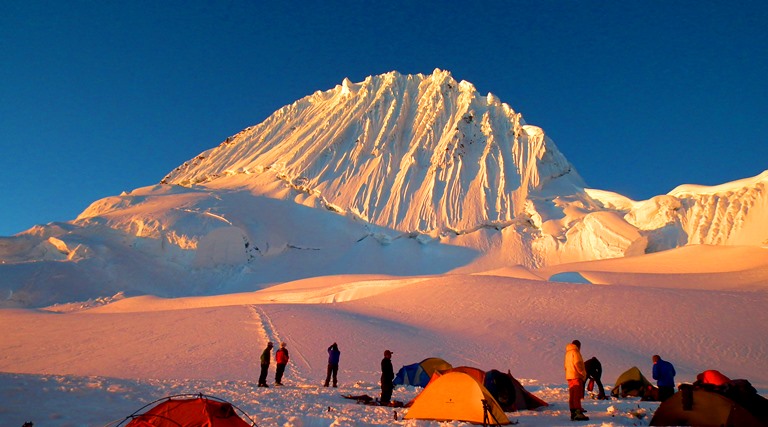
The stunning Alpamayo is one of the world’s most beautiful peaks
Climbing Alpamayo is a challenging but very rewarding adventure. Maybe you have climbed Island peak and want to experience the mighty Alpamayo. We will acclimatize and prepare by climbing Pisco at 5,750m (18,865ft), known as one of the easiest mountains in the Cordillera Blanca Mountain Range in Peru.
Pisco is generally used for acclimatization for one of the 6,000m (19,685ft) peaks in the area.
Other than the altitude, the normal route up Pisco is straight forward. Our trip heads through Huaraz to the top of Pisco and back, which will take 4 or 5 days. Pisco is a spectacular pyramidal peak set right in the heart of the cordillera Blanca and the perfect lead-up to climbing Alpamayo.
Arrive in Lima. You will be met at the airport and transferred to your Hotel. You can relax or head out to explore Lima at your own leisure.
We will drive by bus from Lima to Huaraz (3,090m/10,138ft) in the north. This is an 8 hour trip through the Pervian Hills and upon arrival a rest will be needed for tomorrows trek.
Today we will do an acclimatization day trek. We will make our way up to Laguna Churup at 4,450m (14,600ft).
Huaraz to Llanganuco. We will move up to Pisco Base Camp which is at 4,300m (14,108ft). We head out past the beautiful Llanganuco Lakes and on to the trail head where we load our donkeys and ascend to the Pisco Base Camp.
Today we will head from our Base Camp Pisco to the Moraine Camp at 4,765m (15,633ft). This climb crosses a challenging rock glacier before climbing steeply into camp in a small sandy basin just below the glacier.
Summit Day! Moraine Camp to the summit of Pisco (5,750m/18,865ft) and back to Base Camp at 4,300m (14,108ft). We will wake up at 3am and after a light breakfast depart for the summit. Arrive at the summit around 7 or 8am and discover why everyone talks about this stunning view! Return to camp and continue on back down to the Base Camp.
Today we will head from Base Camp back to Huaraz to rest up and recover for Alpamayo.
Free day in Huaraz to relax and recover from the previous few days climbing. In the afternoon you will get all your gear ready for Alpamayo Climbing.
From Huaraz we pass through Cashapampa on the way to Llamacorral Camp at 3,750m (12,303ft). Drive to the trailhead in the village of Cashapampa (2,750m/9,022ft). This 3 hour drive takes us through beautiful farming communities as we head between the spines of the Cordillera Negra and the Cordillera Blanca. After organizing our burros, we trek with your day pack to Llama Corral (3,750m/12,303ft), where we will camp for the night.
Llamacorral Camp to Base Camp Alpamayo at (4,200m/13,780ft). Today will be a fairly short day, about 2 or 3 hours carrying only our day packs. Our base camp will be set up in a valley at the base of Alpamayo on the opposite side of the route. Our base camp is a stunning place , with greenery, running water and out houses.
Base Camp to our Moraine Camp at (4,600m/15,092ft). From base camp, the route takes a moraine ridge and crosses rock slabs across the edge of the glacier to reach an area of tent platforms, approximately a 3 hour trek. This camping area is very limited and we may opt to climb all the way to Col camp in one day.
Moraine Camp to Camp 1 on Alpamayo at (5,300m/17,388ft). The route above moraine camp continues over ice and moraine before a (300m/ 984ft) snow couloir leads to the Col between Alpamayo and nearby Quitaraju (6,040m/19,816ft). This section can sometimes be the most technical and difficult part of the route. After getting to the col, there is a short descent to reach our high camp.
Camp 1 to the summit of Alpamayo (5,947m/19,511ft) and back to Base Camp at (4,200m/13,780ft). On Alpamayo Summit Day, we will depart from camp at 1 or 2 am and head to the steep summit wall, which offers 360m/1,181ft of fun technical climbing to the summit. This is strenuous but rewarding and your view off the summit is nothing less than spectacular.
Base Camp to Llamacorral Camp. We will trek out to Llamacorral Camp approximately 3 hours from Base Camp of Alpamayo and will camp in Llamacorral.
Llamacorral trek to Cashapampa and return to Huaraz. Time to relax after the climb and reflect on the successful summit and enjoyable journey.
Today we will journey back to Lima and arrive in the afternoon and transfer to hotel or to your onward journey.
1. Understand the Technical Nature
Alpamayo is a technical alpine climb, not just a high-altitude trek. The summit pyramid involves sustained 50–60° snow and ice climbing, often on fixed lines. You’ll want to feel comfortable front-pointing for extended periods and handling rope systems confidently. The more at ease you are on steep terrain, the less energy you’ll spend managing stress when it counts.
2. Arrive Strong, Not Just Fit
General fitness will only take you so far. What you really need is strength endurance, the ability to keep moving uphill steadily for hours in boots and with a pack on your back. Build your training around sustained uphill efforts and long continuous climbs rather than short, intense bursts.
3. Take Acclimatization Seriously
Alpamayo sits at nearly 6,000m, and even though it’s lower than Huascarán, acclimatization still plays a big role in how you perform and how safe you stay. A structured plan that includes climbs on nearby peaks will make a real difference come summit day.
4. Prepare for the Exposure
The summit pyramid is steep and visually intense. It’s not uncommon to feel a little overwhelmed when you look up. Breaking the climb into smaller sections, focusing on your breathing, and keeping a steady rhythm will help you stay calm and move with control.
5. Get Your Gear Right
Technical boots, sharp crampons, a well-fitted harness, and reliable cold weather layers are all non-negotiable. Gear that doesn’t fit well or isn’t up to the task can make an already demanding climb feel significantly harder. Test and wear everything before the expedition so there are no surprises on the mountain.
1. Train For Endurance
Aim for 4 to 5 endurance sessions per week, whether that’s long hikes, uphill treadmill walking, stair climbing, or trail running. Focus on sustained efforts of 60 to 90 minutes at a steady, moderate pace. As your fitness builds, introduce a weighted pack to better simulate what the expedition will demand. A strong aerobic base helps you recover faster between rotations and perform better at altitude.
2. Train For Strength
Twice a week, bring in some leg focused strength work. Step-ups, walking lunges, squats, Romanian deadlifts, and core exercises are all great options. Keep the weight moderate and the repetitions higher, the goal is muscular strength, not maximum power. This kind of training prepares your body well for sustained climbing on steep snow.
3. Train for Steep Terrain
If you can, get time on steep snow or ice before the expedition. Indoor dry-tooling walls or ice climbing sessions are both excellent ways to prepare. Practice in your mountaineering boots too, so your body gets used to the real conditions. The more specific your preparation, the more confident you’ll feel when it matters.
4. Practice Back-to-Back Training
Mountaineering asks a lot of you over multiple consecutive days, so your training should reflect that. Schedule long hikes or uphill sessions on back-to-back days to get a feel for expedition fatigue. Learning to move well on tired legs is one of the most valuable things you can do for summit day.
5. Work on Core Stability and Balance
A strong core makes a real difference when you’re climbing steep terrain or moving roped up. Add planks, rotational exercises, and single-leg balance work into your routine. Better stability means less wasted energy and more control on exposed ground.
6. Start Early and Stay Consistent
Give yourself 3 to 5 months of structured preparation. Build your training load gradually and avoid jumping up in intensity too quickly. Consistency is what builds the durability Alpamayo requires, not extreme sessions. Arriving healthy, strong, and confident will serve you far better than pushing too hard in the final weeks.
Safety and acclimatization are at the core of everything we do on Alpamayo. At 5,947m, the steep and technical summit pyramid calls for a disciplined, well-paced approach. We build proper acclimatization time into every expedition and follow a measured ascent plan because, in our experience, that’s what makes the biggest difference to both safety and summit success.
Our lead guides are internationally certified, wilderness first responder trained, and highly experienced in the Cordillera Blanca. They know this mountain well, its terrain, its conditions, and the judgment it takes to climb it safely.
The itinerary we’ve refined over years of expeditions is designed to give you the best possible chance of reaching the summit, with smart pacing and a clear plan from start to finish.
Q) What is the best time to climb Alpamayo?
The best months to climb Alpamayo are June, July, and August. This falls within Peru’s dry season, when conditions in the Cordillera Blanca tend to be more settled and predictable.
Q) How difficult is Alpamayo?
Alpamayo is one of the most technical classic climbs in the Andes. The final summit pyramid involves steep snow and ice, so you’ll need solid technical climbing skills to get there safely.
Q) Do I need previous mountaineering experience?
Yes, prior experience is important. You should be comfortable with crampons, ice axe, and fixed lines before attempting this climb. We’d also recommend having completed other technical alpine peaks beforehand.
Q) How high is Alpamayo?
Alpamayo sits at 5,947m (19,511 ft) in Peru’s Cordillera Blanca.
Q) How long is the expedition?
Most expeditions run between 10 and 14 days. This gives enough time for proper acclimatization and some flexibility if the weather doesn’t cooperate.
Q) What are the main challenges?
The steep terrain, altitude, and unpredictable alpine conditions are what most climbers find most demanding. Coming well prepared and having an experienced guiding team alongside you makes a real difference.
Country:
South America
Duration:
16 Days
Distance:
65 km
Max. Altitude:
5,947m / 19,511 ft
Difficulty:
Medium
Group Size:
12

Does this information excite you to take the next step towards achieving your goals in the mountains? If so, get in touch today.