First can I say thank you to you and all of your staff for what was an amazing trek to EBC and KP 😊 I loved every minute, felt completely…
Read more


Overview
Climbing Ama Dablam requires a longer expedition with expert guides.
A Longer Ama Dablam Itinerary offers you better acclimatization, safety and summit opportunity. Our Ama Dablam expedition follows a deliberately longer itinerary, giving climbers more time to acclimatize, recover between climbing stages and prepare for the summit attempt. That additional time supports a gradual approach to altitude and greater flexibility when weather or mountain conditions change.
Drawing on 15 years of leading Ama Dablam climbs, we build this time into our itinerary to support safer decisions and give well-prepared climbers the best possible opportunity for summit success. Individual acclimatization and mountain conditions ultimately guide each ascent.
Climb Ama Dablam: 15 Years of Expedition Leadership
Climbing Ama Dablam is about more than reaching a Himalayan summit. It is the experience of moving along an exposed ridge, climbing rock above the Khumbu Valley and stepping onto steep snow with Nepal’s great mountains around you. The mountain demands technical skill, endurance and confidence. Ama Dablam deserves an itinerary that gives you time to prepare and be successful.
We have been leading Ama Dablam expeditions for 15 years. Over the years we have refined our approach combining that experience with a deliberately longer itinerary, allowing more time for acclimatization, recovery and flexibility on the mountain.
For climbers choosing an Ama Dablam expedition, those extra days serve a clear purpose: supporting sound decisions and creating more opportunity to attempt the summit when preparation and conditions align.
The Ama Dablam Climb
The classic Southwest Ridge offers varied climbing on rock, snow and ice. As the route rises above base camp, the terrain becomes more exposed, with narrow ridges and technical sections requiring concentration and efficient movement.
Fixed ropes assist progress on steep ground, but climbers still need the skills to ascend and descend confidently. Managing equipment, moving with a pack and maintaining a steady pace all become more demanding at altitude.
This combination makes Ama Dablam a rewarding objective for experienced mountaineers seeking a technical Himalayan climb. It also requires you to be more self sufficient.
Technical Preparation for Climbing Ama Dablam
Climbing Ama Dablam requires strong mountain skills alongside endurance. Practice rock climbing in mountain boots and gloves, develop confidence on exposed terrain, and arrive proficient in fixed-rope ascent, traversing and repeated abseils. Multi-pitch climbing experience helps build efficient movement, rope management and organization. Test your equipment and clothing together before departure, and prepare for the technical demands of the descent as carefully as the ascent.
Why Additional Acclimatization Days Matter
Additional acclimatization days can make a real difference when they support gradual altitude gain, recovery and flexibility. They give climbers more opportunity to adapt before moving higher and allow the team to respond to individual progress.
At Ian Taylor Trekking, our 15 years of leading Ama Dablam climbs inform our deliberately longer itinerary. We allow additional time to support acclimatization, considered decisions and summit opportunity. Extra days cannot guarantee safety or success, but a well-planned schedule provides valuable room to adjust.
We require previous rocking experience up to 5.8. We also require a proven track record of climbing above 5,000m on fixed lines and being comfortable on peaks like Mera Peak Lobuche peak. Ama Dablam is a technical, physical and mental mountaineering challenge. You do need to have Alpine and fixed line mountaineering experience before taking on this challenging expedition. Get in touch with our team and learn more about this unique and exciting adventure in Nepal.
Optional helicopter return
We can arrange helicopter returns as a tailored option on our Nepal trips, with pickup possible from many villages in the Everest and Annapurna regions. We will confirm a suitable pickup location and how it fits your route. Ask us about pickup options and pricing for your itinerary. Flights are subject to weather and operational availability.
Upcoming Trips
2027
2028
2029
Jan
Feb
Mar
Apr
May
Jun
Jul
Aug
Sep
Oct
Nov
Dec
No trips found for Jan 2027.
No trips found for Feb 2027.
No trips found for Mar 2027.
No trips found for Apr 2027.
No trips found for May 2027.
No trips found for Jun 2027.
No trips found for Jul 2027.
No trips found for Aug 2027.
No trips found for Sep 2027.
No trips found for Nov 2027.
No trips found for Dec 2027.
Jan
Feb
Mar
Apr
May
Jun
Jul
Aug
Sep
Oct
Nov
Dec
No trips found for Jan 2028.
No trips found for Feb 2028.
No trips found for Mar 2028.
No trips found for Apr 2028.
No trips found for May 2028.
No trips found for Jun 2028.
No trips found for Jul 2028.
No trips found for Aug 2028.
No trips found for Sep 2028.
No trips found for Nov 2028.
No trips found for Dec 2028.
Jan
Feb
Mar
Apr
May
Jun
Jul
Aug
Sep
Oct
Nov
Dec
No trips found for Jan 2029.
No trips found for Feb 2029.
No trips found for Mar 2029.
No trips found for Apr 2029.
No trips found for May 2029.
No trips found for Jun 2029.
No trips found for Jul 2029.
No trips found for Aug 2029.
No trips found for Sep 2029.
No trips found for Nov 2029.
No trips found for Dec 2029.
Itinerary
1
DayArrive in Kathmandu – 1,400m/ 4,500 feet
Arrive in Kathmandu International Airport as early as possible on this day. We will provide your airport transfer to the hotel we include for the night. All accommodation on the trek is on a shared basis. If you want to arrive early, that is not a problem, we are happy to book additional nights in the hotel for you. We will have a group briefing this evening to go over the schedule for the coming days and answer any additional questions you may have.
2
DayTrek to Monjo – 2,850m/ 9,350 feet
Our goal for this trip is to fly out of Kathmandu directly to Lukla. *See the note at bottom of the itinerary. If this is not possible. The team will be up early for a 2am departure from Kathmandu for the long 4-hour drive to Rammechhap Airstrip in the Manthali district for an early Flight to Lukla. From Ramechaap we will take a 15-minute flight to Lukla (2,840m/9,317ft), the gateway to the Khumbu Region. This is an exciting flight, which should give a glimpse of Everest in the distance. In Lukla, we will meet the rest of our staff and set off straight away for our first night in the mountain village of Monjo. Depending on what time the flight arrives in Lukla, we may have to stop in the town of Phakding (2,600m/ 8,530 feet) for the night. Hopefully, the team will make it all the way to Monjo. Both villages are situated on the banks of the Dudh Kosi, which drains the whole of the Khumbu Region, and is the main trade route for the entire region. This can be the busiest part of the trail. Today we will walk for 3 hours to Phakding and a total of 5/6 hours to Monjo. The total distance is 8.8 miles/ 13 km to Monjo from Lukla.
3
DayNamche Bazaar – 3,440m/ 11,286 feet
Today we will continue up the banks of the Dudh Kosi River, towards Namche Bazaar. Just past Monjo, we will officially enter the Sagarmatha National Park before following the trail through small villages. We will take a tea break along the way. After tea, the trail then crosses the confluence of the Dudh Kosi and the Bhote Kosi, on a high suspension bridge. The trail then climbs steeply uphill for about two hours to reach Namche Bazaar (3,440m/11,286 feet). This is a prosperous trading town and the capital of the Khumbu Region. Just across the valley to the east stand the peaks of Thamserku and Kangtega, both very impressive mountains. From Monjo, the trek today is approximately 4 hours, and the total distance is 5 miles/ 8 km.
4
DayAcclimatization Day – 3,600m/ 11,800 feet
Today is an acclimatization day where we will walk to the Sherpa Museum at 3,600m/ 11,811 feet. From here you will have stunning views of Mount Everest, Ama Dablam and the surrounding mountains. The key is to rest, relax and acclimatize at this height and will make all the difference as we go to high and extreme altitude. You can take the afternoon to relax, walk the back street of Namche Bazaar and enjoying the sites! Remember that it is still important to continue to drink 4-5 liters of water every day on the trail.
5
DayAcclimatization Day) – 3,900m/ 12,800 feet
This is where our itinerary is different. Instead of heading up to 3,900m/ 12,800 feet and sleeping in Tengbouche, we will stay in Namche another night giving you the best possible acclimatization program. During this critical acclimatization phase, we will spend time resting and trekking to higher altitudes to aid in the process. We will wake early for our acclimatization hike today, up to Shangbouche Hill at 3,900m/ 12,800 feet, for beautiful vistas of the whole Everest Region. The goal is to spend some time acclimatizing at this elevation before returning to Namche for lunch. The afternoon can be spent sampling the delights of the Namche Bakeries and local stores! The hike to Shangbouche Hill will take approximately four hours round trip.
6
DayTengbouche – 3,900m/ 12,800 feet
Today we will leave Namche and trek to Tengbouche at 3,900m/ 12,800 feet. From Namche, the well-worn Everest trail contours around the side of the valley high above the Dudh Kosi. As we follow the path, we will get excellent views of the great peaks of the Khumbu; Everest, Lhotse, Nuptse and Ama Dablam. Passing by several villages, we will descend approximately 300m/ 984 feet down to the Dudh Kosi River, where we stop for lunch. After lunch, we will make the steep 700m/ 2,296 feet uphill climb to Tengbouche. This is the home of the impressive and famous Tengbouche Monastery. You can visit the Monastery or the local bakery this afternoon. The hike will be approximately 5 to 6 hours today and covers 7.5 miles/ 12 km.
7
DayDingbouche – 4,350m/ 14,271 feet
We will continue up the trail to Dingbouche today. Shaded by Rhododendron trees, the trail crosses an airy suspension bridge just beyond Debouche. From here, the trail continues for approximately an hour before reaching the village of Pangbouche. From here, there are excellent views of Ama Dablam. If there is time, we may be able to visit the famous Pangbocuhe Monastery, which was the first in the Everest Region when the Sherpa people migrated from Tibet into these valleys. Contouring up the valley, we will re-cross the river and turn up the Imja Valley to reach the picturesque farming village of Dingbouche at 4,350m/ 14,271 feet above sea level. The hike will take approximately 5 – 6 hours today and cover 7.5 miles/ 12 km.
8
DayChuckung 4,700m/ 15,419 feet
Today we will hike 3 hours to Chuckung. We will exit the main Everest trail and head for the more remote village of Chuckung. Chuckung is the gateway to the 3 Passes trek, Island Peak and the Amphulaptsa Pass, which leads to Baruntse Peak. Once we reach Chuckung you will have lunch in the sunroom and relax before some challenging days ahead.
9
DayAcclimatization Day! 5,000m/ 16,404 feet
This morning, we will take a 3 hour hike out and back. We will take a nice relaxing hike towards Island Peak for some great views of Ama Dablam, Lhotse, and the Nuptse wall, before returning to Chuckung for lunch. In the afternoon you can relax and rest in the sunroom and prepare for the hike up Chuckung Ri the following day.
10
DayHike up Chuckung Ri 5,500m/ 18,044 feet
Behind the village of Chuckung there is a stunning peak with spectacular views across the Everest region. The day will serve two purposes, acclimatization along with some world class mountain viewing. It takes 3 hours to reach the summit of Chuckung Ri and after taking in some breathtaking views you will return to Chuckung for a late lunch and then rest up for the afternoon.
11
DayPangbouche 4,000m/ 13,123 feet
Today we will retrace our step back down to the main Everest trail, past Dingbouche, down to Shomare and on to Pangbouche for the night. There is no rush today and the team should aim to leave Chuckung around 10am.
12
DayAma Dablam Base Camp 4,600m/ 15,000 feet
From the lodge we will hike down and cross the river before the long ascent up to Ama Dablam Base Camp. This is a slow 4-hour hike to Ama Dablam Base Camp where you will be served lunch. After lunch you can get settled into your tent and relax for the afternoon and admire the mighty mountain that stands in front of you.
13
DayRest day at 4,600m/ 15,000 feet
Today can be used to wash some clothes, relax in Base Camp, and re-organize your gear for moving higher on the mountain.
14
DayMove to Camp 1 5,600m/ 18,372 feet
Today we will slowly ascend to Camp 1 on Ama Dablam and get settled into camp and rest up for the evening. The terrain encountered while hiking from Ama Dablam Base Camp to Camp 1 is varied and demanding, characterized by a mix of rugged trails with rocky slopes. The journey begins with a relatively moderate trek from Base Camp, with paths winding through the picturesque landscape of the Khumbu region. As you approach Camp 1, the terrain becomes increasingly more challenging. The route ascends through rocky moraine, requiring careful navigation on unstable rock. There are sections of loose rock, which demand steady footing and concentration. Throughout the hike, climbers are treated to stunning views of the surrounding peaks, including the iconic Lhotse, serving as both inspiration and distraction from the physical exertion required. Despite the arduous nature of the terrain, reaching Camp 1 marks a significant milestone in the ascent of Ama Dablam, offering climbers a sense of accomplishment and anticipation for the challenges that lie ahead on the journey to the summit. The night will be spent in our tents at Camp 1.
15
DayRest in Camp 1 5,600m/ 18,372 feet
Today we will rest at Camp 1 to add to our acclimatization plan. The team will relax for the day and prepare to move up to Camp 2.
16
DayClimb to Camp 2 5,900m/ 19,357 feet return to Camp 1
The team will start the most technical day of the trip so far as you move along the ridge line and slowly make our way up to the yellow tower. The ascent from Camp 1 to Camp 2 on Ama Dablam is a challenging, yet exhilarating, journey that demands both physical endurance and mental fortitude. Beginning the climb from the steep and rocky slopes of Camp 1, climbers navigate through a maze of rocky boulders. As altitude increases, so does the intensity of the climb, with climbers battling against biting winds and thinning air. The route demands technical proficiency, with sections of almost vertical rock faces requiring precise footwork and rope management. Despite the grueling nature of the ascent, the breathtaking views of the surrounding Himalayan peaks serve as a constant reminder of the unparalleled beauty awaiting those who persevere. We will acclimatize and return to Camp 1 for the night.
17
DayReturn to Base Camp 4,600m/ 15,091 feet
It is time to head back to Base Camp for some rest and recovery. We will take it easy this morning and plan on arriving back in Base Camp for Lunch. The Afternoon can be spent resting and rehydrating.
18
DayRelax in Base Camp 4,600m/ 15,091 feet
Today is a good day to wash some clothing and continue to rest, rehydrate, and reorganize your clothing and equipment. Feel free to go for a short hike with minimal intensity.
19
DayRelax in Base Camp 4,600m/ 15,091 feet
Today is a rest day but you can go through all your gear needed for moving higher on the mountain. Feel free to go for a light hike and rest up before moving higher.
20
DayMove to Camp 1 5,600m/ 18,372 feet
Today we will slowly ascend to Camp 1 on Ama Dablam and get settled into camp and rest up for the evening. This should be an easier hike up to Camp 1 than your first time up there. The terrain and hike will be more familiar and should be more comfortable.
21
DayRest in Camp 1 5,600m/ 18,372 feet
Today we will rest at Camp 1 and add to our acclimatization plan. The team will relax for the day and prepare to move up to Camp 2.
22
DayClimb to Camp 2 5,900m/ 19,356 feet
The team will start moving along the ridge line on the fixed lines and slowly make our way up to the yellow tower. The ascent from Camp 1 to Camp 2 on Ama Dablam is challenging but it should be more familiar to you at this point.
23
DaySummit attempt 6,812m/ 22,350 feet back to camp 2
The climb from Camp 2 to the summit of Ama Dablam is the culmination of a demanding journey filled with technical, physical, and mental obstacles. Setting out from Camp 2, climbers face a daunting array of technical challenges, including steep ice slopes, avalanche risk and exposed ridges. Negotiating these obstacles requires unwavering determination. As climbers ascend higher, the air grows thinner, intensifying the physical strain of the climb. Despite the slow pace and altitude, the allure of reaching the summit will drive you forward. Once you have crossed the mushroom ridge and pass Camp 3 you will have some more gradual slopes that turn into steeper 60-degree fixed line climbing on the right-hand side of the serac, all the way up to the summit. The view from the summit of Ama Dablam is awe-inspiring. Mountaineering is a retrospective enjoyment, so it is important to get back down as quickly as possible. You must carefully navigate your descent back to Camp 2, where they can rest and recover. Sometimes we must continue back to Camp 1 in the same push if the conditions require it.
24
DayBack to Base Camp 4,600m/ 15,091 feet
After some good rest the team will return to Base Camp for the night. It is time to rehydrate and celebrate.
25
DayContingency day
Depending on other teams, weather, and the summit plan we may break the team into two groups for the ascent. This day is a spare day that can be used for rest, moving up or down the mountain.
26
DayContingency day
Depending on other teams, weather, and the summit plan we may break the team into two groups for the ascent. This day is a spare day that can be used for rest, moving up or down the mountain.
27
DayTrek to Namche Bazzar 3,440m/ 11,300 feet
From Ama Dablam Base Camp we will hike downhill to lower Pangbcouhe. From there we rejoin the main Everest trail to Tengbouche for tea. We will continue downhill for one hour to our lunch spot, beside the river. After lunch, there is a one hour and thirty-minute ascent, back up to the Ama Dablam View Guesthouse, where we will have a final short break. There is another approximately hour and thirty minutes before we reach Namche Bazaar. This is a long day as we will only arrive in Namche in the late afternoon. It is now time to take a shower, relax and get some rest! The hike today is approximately 7 hours and will cover 11.5 miles/ 18.5 km.
28
DayTrek to Lukla 2,800m/ 9,200 feet
Today is the final day of trekking!! It will be another long day as we must get all the way back to Lukla for the night. The day starts with a one-hour descent from Namche, back to the high suspension bridge. Following the river from here, you will have to trek up and down stairs and trails, retracing our steps back to Phakding, where we will stop for lunch. After lunch, it will be a gradual two-and-a-half-hour ascent back into Lukla at 2,850m/ 9,350 feet. The hike today will take approximately 7/8 hours and we will not reach Lukla until late afternoon. The distance covered today is 13 miles/ 21 km and you will enjoy your final night spent in the Everest Region tonight.
29
DayFly back to Kathmandu 1,400m/ 4,600 feet
We will wake early today and have breakfast before returning to the Lukla Airport for the flight back to Kathmandu. If the weather is cooperating, then you would be back in the hotel in Kathmandu by early morning! You can spend the day at Leisure in Kathmandu, enjoying the sites, including Pashupatinath, Swayambhunath and the districts of Bhaktapur and Patan. Durbar Square is also on the essential list, as is the shopping area of Thamel or get a treatment at one of the many spas in Kathmandu. We include a celebration team dinner in a nearby restaurant and the night in the hotel is also included on a shared basis.
30
DayTransfer to the Airport for your International flight
Today is the final day of our itinerary. We recommend that you do not book your return flight until no earlier than the evening on this day. That will be critical if there are any delays getting out of the mountains on the day before. We include your return transfer back to the international airport for your onward journey. If you want to spend any extra time in Kathmandu, we are happy to book additional nights for you in the hotel.
Inclusions
Trip Cost Includes:
- 6 Guides for every group of 6 climbers
- Internal flights – Always aim to have first few rounds of flights per day
- Professional trekking and climbing guides
- Porterage of gear (Carrying 15kg/33lb per person Maximum)
- All group safety equipment
- 2 nights hotel and breakfast in Kathmandu (2 people sharing, 4 Star)
- All lodge/tent accommodation when in mountains
- All trekking permits, climbing permits and National Park fees
- Insurance and medical cover for our staff
- Full time office support on the ground in Kathmandu
- Airport Transfers to/from International Airport in Kathmandu
- Using the communal medical kit (you will need a personal kit as well)
- 3 meals a day while in the mountains
- 5 days a week expert support prior to trip
- Celebratory final meal in Kathmandu
Trip Cost Does Not Include:
- Nepalese Visa entry fee ($50, which can change at any time)
- International flights
- Trekking insurance (compulsory)
- Tips for Guides/Porters (approximately $1,200)
- Personal equipment
- Meals and drinks while in Kathmandu (excluding Breakfast)
Advice
10 Reasons to pick us for your trip
1. Fixing our own Ropes
All our trips have three nights in Namche on the way up the trail, along with more acclimatization. Our itineraries also has a night in chuckung to aid in the preparation for Ama Dablam. Our team are available to our clients, giving them all the information they need before this challenging adventure. Read some Reviews from our trips.
2. Our Team
Ian Taylor Trekking have 6 guides for every group of 6 climbers. We have a maximum of 6 climbers per team along with our support team so we can carry ropes and mountaineering equipment high on the mountain. Safety is our priority on Island Peak. We want to make sure all of our teams have the best chance at safely reaching their goal. With more staff on the trail with your team, they will be able to more efficiently manage your safety on the trail and mountain and also give you a better experience along the way.
We do not outsource any of our trips in Nepal and we have our own office in Kathmandu and our own staff who manage all of our trips. Therefore, this gives us far more consistency in our service on the ground. We have world class climbing Sherpa’s working with us and therefore, this helps us offer you quality trips to Island Peak.
3. Supporting the Community
We continue to support the local community and have helped to establish the lan Taylor Trekking Foundation 501 (c) (3). This was put into place after the earthquake in 2015, when the Village where many of our staff have come from was devastated. We have built four schools in the Goli region and we have placed stoves in over 200 homes. We do need donations and help, therefore if you would like to donate, set up a trek to the village, give funds, clothes or school items, then get in touch. Please let us know and we can help you figure out how you can best help!
4. Quality Run Trips
We run only run quality treks with more staff, better lodges and better food. Read some REVIEWS from our trips. You can also watch our Food and Accommodation video for further information. A lot of times people are only given the same food each day for every meal, and we don’t do this. You are allowed to pick what you eat for each meal to make sure that your dietary needs are met.
We pay our staff correctly and do not over load them with weight. Also, we use Yaks to carry all the loads up to Ama Dablam Base Camp and porter/climbing support above Base Camp. We do not cut corners on any aspects of our treks or climbs.
4. Expert Training Advice
We offer personal service with training advice for our clients, 5 days a week. A lot of people underestimate Lobuche Peak. We do not want to see this happen with our clients. Therefore, we want to make sure that you have the best information on how to complete this trek and climb safely and successfully. Learn more. The summit night and day alone can be 14 hours with some technical challenges. We run courses in Colorado and Scotland in support of our Island Peak climbs.
There are some long 8+ hour days, covering over with over 1000m/ 3,280 feet of up and down hill on steep challenging terrain.
6. More Acclimatization
We have learned after years of experience that people need more time to acclimatize to the lower levels of oxygen, in order to have a safe and successful trip to 22,349 feet. Therefore, we now include three nights in Namche Bazaar at 3,500m/ 11,500 feet. Trek to chukung and Chuckung Ri at 5,500m/ 18,044 feet prior to reaching Ama Dablam Base Camp. We include contingency days for summit attempts.
This will help to give your body the time it needs to acclimatize correctly. Most companies are not doing this and we have seen over the years that it is a main factor in why more people on our trips are making it safely to the summit of Ama Dablam!
7. Climb with an Everest Summiteers
All of our trips are led by Everest Summiteers and have extensive experience on Ama Dablam. You will climb in the Everest region with guides who not only climbed Everest, but also has reached the top of Ama Dablam over 10 times! If you climbed with us before you will be climbing with the same guides on Ama Dablam.
8. 25 Years Experience
We have years of experience managing teams on the ground in Nepal. Our head Climbing guide DJ Sherpa has climbed Island and Lobuche Peaks over 100 times and climbed Mount Everest numerous times. Our head trekking guide Dawa Sherpa heads up our office in Kathmandu. Both are very passionate about Sherpa culture, experience and preserving these traditions. Anyone who has trekked with either Dawa or DJ will never forget it!
9. Fully Trained Staff
All of our guides hold current Wilderness First Aid Certificates and mountaineering guiding qualifications. Also, our guides will carry satellite and local phones with them in case of an emergency. All our guides will have led many trips on Island peak, Mera Peak, Lobuche, Tent Peak, Everest North Col, Cho Oyu, Ama Dablam and Mount Everest and so many more.
10. Quality Equipment and Gear
On our Ama Dablam climbs, we use quality, North Face Tents. We use these tents on all our trekking and mountaineering itineraries in Nepal. There is an option for a single tent for your nights sleeping at Ama Dablam Peak Base Camp. All our mountaineering gear is stored in Lukla and we bring new ropes for every season of climbing. Our Yaks and support staff carry all equipment up to Camp 1 along with our support staff carry mountaineering equipment and ropes high on the mountain.
Top 10 Tips for Climbing Ama Dablam
Ama Dablam is highly underestimated by so many people. Ian Taylor Trekking use a longer itinerary offering better safety and success.
Ama Dablam deserves serious preparation. Its dramatic ridges attract climbers from around the world, but technical terrain, exposure and altitude make this a demanding Himalayan expedition.
At Ian Taylor Trekking, we have been leading Ama Dablam climbs for 15 years. We deliberately use a longer itinerary to allow more time for acclimatization, recovery and changing mountain conditions. Our aim is to support safer decisions and give prepared climbers a strong opportunity to attempt the summit.
These ten tips explain what to consider before climbing Ama Dablam.
1. Understand the Difficulty of Climbing Ama Dablam
Do not judge Ama Dablam by its altitude alone. The climb combines rock, snow and ice with significant exposure. A strong trekking background is useful, but technical mountaineering experience is essential preparation.
Assess your ability to move confidently on steep terrain, manage equipment and descend efficiently after a demanding ascent.
2. Choose an Itinerary That Allows Time to Acclimatize
Look beyond the total trip length and examine how the days are allocated. Gradual altitude gain, acclimatization opportunities and recovery time all matter. Individuals adapt at different rates, so flexibility is valuable.
Ian Taylor Trekking’s longer itinerary makes time a deliberate part of expedition planning. Extra days support acclimatization and leave more room to respond to conditions; they cannot guarantee adaptation or a summit.
3. Arrive With Confident Fixed-Rope Skills
Using an ascender efficiently and managing rope transitions should be familiar before you reach the mountain. Learn and practice the expedition’s required systems with a qualified instructor.
Base camp practice should refresh established skills. It should not be your first introduction to equipment you will depend on in exposed terrain.
4. Practice Abseiling Before the Expedition
Preparing for the descent is as important as preparing for the ascent. You need confidence abseiling on steep ground and managing your equipment when tired.
Build these skills through supervised practice, including repeated descents and transitions. Familiarity helps you maintain concentration and avoid rushed decisions late in the day.
5. Train for Sustained Mountain Days
Ama Dablam training needs to develop endurance alongside technical ability. Prepare through progressive uphill hiking, appropriate pack carrying, strength work and regular climbing.
Train consistently over several months, with the workload matched to your starting fitness and expedition requirements. Include descents in your preparation: your legs still have substantial work to do after reaching the summit.
6. Build Experience on Exposed Rock, Snow and Ice
Indoor climbing and gym fitness are useful foundations, but outdoor mountain experience adds different demands. Practice moving on varied terrain with boots, gloves and a pack.
Develop confident crampon and ice-axe skills, and become comfortable with exposure through suitable guided progression. Efficient movement helps conserve energy throughout the climb.
7. Test Your Equipment Before Leaving Home
Obtain the current expedition kit list and check your equipment well before departure. Confirm boot and crampon compatibility, glove dexterity, harness fit and access to essential items.
Practice with the equipment you will actually use. Discovering an awkward clothing combination or poorly fitting boots at home gives you time to resolve it.
8. Make Eating, Drinking and Camp Organization Routine
Personal organization matters over a long expedition. Keep food, drinks, warm layers and essential equipment accessible, and establish reliable routines at camp.
Discuss high-camp food and dietary needs before departure. Carry suitable snacks and plan how you will access food and drinks during climbing days, following your team’s guidance.
9. Assess the Team Behind the Expedition
Ask who will lead the climb, what experience they have on Ama Dablam and how support is arranged during each stage. Understand guide ratios, staff responsibilities, communications and contingency arrangements.
At Ian Taylor Trekking, our 15 years of leading this climb and deliberately longer itinerary are central to the expedition we offer. We encourage climbers to discuss their experience and preparation with us before booking.
10. Stay Flexible About the Summit
Weather, route conditions and individual readiness must guide the summit decision. Arrive prepared to adjust the plan and follow your climbing leader’s judgement.
A longer itinerary can provide additional flexibility, but the mountain still determines what is possible. Conserving enough energy for the descent and being willing to turn around are essential parts of responsible climbing.
Prepare for Ama Dablam With Ian Taylor Trekking
Bring your ambition—and give preparation the time it deserves. With 15 years of Ama Dablam expedition leadership and a longer itinerary designed around acclimatization, recovery and flexibility, we help you plan for the demands of this mountain.
Contact Ian Taylor Trekking to discuss your climbing background, review the itinerary and explore upcoming Ama Dablam expeditions.
Training
Specific Training for Ama Dablam
Ama Dablam is a Mountaineering Peak
The first thing to remember is that Ama Dablam is constantly changing. The route, terrain and the glacier changes from one season to the next. Specific technical training is needed for Ama Dablam and we do require it from all of our clients. There have been a number of deaths in recent years so having the correct itinerary, acclimatization and professionals around you will make all the difference.
Be Ready for Anything
All our guides have 10+ Ama Dablam Expeditions under their belts, and each one of those expeditions has been totally different than the last.
The climb can be very challenging if there is a lot of snow, if there has been no snow and higher temperatures, then you will find an icy head wall, and undulating ice climb, which can make it an easier or harder climb to the summit. Because you never know what the conditions will be, you must not show up under prepared!
Be Physically Ready for Ama Dablam
When it comes to mountaineering, you want to be training harder than you think. You could encounter an ice wall with no rest for your calves. You could encounter deep snow and you need to be fully prepared for the hard slog. The conditions could be such that you could have over a twelve hour summit day before getting back to Camp 2. Likewise, we have had teams have 14 hour summit days! When it comes to any mountaineering trip, you need to be in excellent physical shape so that you can be ready for whatever is thrown at you.
Specific Mountaineering Training
When it comes to preparing for going up the head wall, you need to find 60 degree angle terrain. Have a guide set up ropes with 4 to 5 different anchor points. You will have a jumar on a sling or cows tail, attached to your harness. You should also have a sling (safety line) with a carabiner on the end of the sling. The carabiner should be able to go above the Jumar on the fixed line. You do not want the Jumar going higher than your nose when fully tight.
The key mountaineering training should be for going down the head wall. You will want your safety line with carabiner on the fixed line. The safety should be kept above the figure of 8 (descending device) as you abseil down. You need to be comfortable abseiling using a figure of 8 and learning to flip the figure of 8 over once you reach each anchor point. Making sure your safety line is tight as you find the next abseil. Once you have found the rope and you are safe with the figure of 8 to abseil, then and only then, do you take the safety line from above the anchor point and place on the rope you are abseiling on. This training is important for your safety!!
You will have to abseil or rappel down the head wall using a figure of 8 above 6,300m/ 20,670 feet. You will need to have the leg strength to get you up and down steep terrain. Importantly, you will need to be very comfortable using ropes, Jumar (ascender) and abseiling using a figure of 8 device on fixed lines. This is extremely important for your safety and the safety of the team and our guides.
Specific Physical Training
Fitness is important, but being lean, lighter, stronger and fast is really important when climbing these big mountains. Do not under estimate the Ama Dablam challenge. We recommend physical training 6 days a week. Focus on two main elements of building strength and endurance.
Build up Your Training Over Time
Our recommendation is to be training 6 days a week. One day should be dedicated to long hikes up and down hills with a weighted backpack. Train on a stair master and/or 20/30 degree incline treadmill 5 – 6 days a week, starting with minimal weight in your backpack 5kg/ 11lbs. Then, we recommend slowly building up to carrying 15kg/ 33lbs. You need to train to specific heart rates, therefore doing a fitness test is a very good idea prior to developing a training plan. You should be doing most of your training in the endurance zone. Building from 1 to 2 hours 30 minutes per day for four or five sessions a week.
Also, you need a longer endurance session, once per week. This longer endurance session is best completed up and down hills with weight in your backpack. However, if you do not have access to hills, it can be done on a bike doing a long ride or in the gym mixing up the machines you use. We can help you figure this one out to suit your specific situation.
You should be looking at building from 6 to 12+ hours of training per week. Each month you should be trying to increase the weight you carry and the time spent doing the activity. After 2 months, you should start adding in some weight training, developing your quads, calves, and core. In the last 2 months, you should consider adding in interval training, all while you are still doing the endurance training building up the weight you are carrying.
Strength and Endurance Training
Your Ama Dablam summit day could be 12 – 14+ hours, depending on conditions. Therefore, you need to have the strength and endurance to be able to manage this long day after weeks at high altitude to get to this point. Also, remember that you will then still have to walk back to Lukla. If you are signing up to one of our climbs, then we will work with you to make sure you are getting the experience needed for this exciting and challenging climb.
Training For the Downhill
Not everyone will have access to hills, but this is the best way to train your body and legs for down hill hiking. Depending on your chosen adventure you do need to assess the level of downhill. We have elevation gains available for all of our key trips. I encourage you to review the daily elevation drops and what type of terrain you will be walking on.
For example, on our Inca trail treks you will be drop 700m/ 2,296 feet to 1,000m/ 3,280 feet on different days all on steep rocky stairs. On Kilimanjaro you will drop 2,800m/ 9,186 feet in one day on scree and rock and this is very challenging on your legs and joints.
You have just walked for days on end you have reached your goal but not you have to retrace your steps, often in a quicker time frame. Hiking downhill will take its toll on your joints. Fore sure, the downhill hike will take more wear and tear on your joints and muscles than the uphill.
You do need to use effective training techniques to minimize the impact on your body. Descending using good technique means that you move faster and feel lighter. Remember, 80% of accidents happen on the way down.
Keeping Knees Healthy
We live in Eagle-vail Colorado with amazing access to altitude and a wide range of mountain terrain to train on. In Colorado we can train all year round on hilly terrain preparing for Kilimanjaro, Himalayan trekking and mountaineering trips. I know most of you are joining our trips from sea level and with minimal access to hill training. I encourage you to get out to Colorado doing some multi-day hiking in preparation for your chosen adventure.
If you do not have access to hills and mountains, you must figure out other ways to prepare your knee joints to handle downhill stress. From a knee perspective, downhill hiking means eccentric loading and typically thousands of repetitions of it. Eccentric loading (the lengthening phase of a contraction) is especially challenging to what is called the patellofemoral joint of the knee. This is where the knee cap, meets the femur. Inadequate strength, poor mechanics and lack of exposure to this type of loading can turn downhill forces into injury producing stress. Prior to your trekking trip you need to start implementing sport specific training into our general preparedness programming.
Hiking Uphill and Downhill
Hiking uphill is all concentric muscle action (muscle active while shortening) at the knee joint without any eccentric loading (loading while muscle is lengthening). Concentric only exercises tend to cause less mechanical stress, load and pain to joints and tendons than do exercises that have eccentric phases. What goes up must come down.
You must prepare our body and specifically your knees to handle downhill hiking. Depending on the trip, you really need 6 months of some sport specific training into our general preparedness programming.
The strength movements below are similar but slightly different in specific ways. We purposely only hit each one once per week because too much volume of these exercises could quickly lead to an over training injury, so be careful. I would recommend adding in additional hip flexor and quadriceps mobility work at the end of your training sessions as well to maintain good length tension relationships and to protect your spine.
The Point of These Exercises
Increase vertical loading volume of the knees with a sight posterior to anterior (back to front) force vector. Get exposed and accustomed to decelerating the vertical and forward forces using primarily a knee strategy. Transition from doing most lunges and squats with a 3 points of contact foot position to a more heel elevated position where we contact and press through the forefoot.
The 3 points of contact foot position is the most stable position for the foot and encourages a balance of hip and thigh musculature – great for general preparedness training. Transitioning to a heels elevated position where the forces are applied through the forefoot places most of the stress on the quadriceps and knees – optimal for downhill hiking training.
Exercises for Downhill Hiking
You should consider adding these movements into your weekly training 2 times per week. Add 3-5 sets of 10-15 repetitions (per leg)
1. Heels Elevated Goblet Squat
2. Forward Alternating Lunge with Farmers Carry Loading
3. Forward Alternating Drop from Box Lunges
4. Banded Posterior to Anterior (PA) Forward Lunges
Carrying Weight
One of the best ways of mitigating the risk of musculoskeletal issues is by carrying a light pack. Then build up the weight you carry over time. An overly heavy backpack is not recommended in the early stages of your training.
Extract its biggest toll on your body during steep and/or long downhill sections, so a hiker should always aim to travel as lightly as the dictates of their skillset and the environment into which they are venturing allow.
If you are carrying weight on longer hike you should slowly build up the weight you carry. You should also consider carry water uphill and dump as much water/ weight as possible for your downhill. Always assess the weight you are carrying for each hike and always build up slowly over time. You do not want to get injured.
Equipment
Packing for Ama Dablam
Making sure that you have the correct gear and clothing for the trip will be essential to your comfort and ultimately your success on the mountain. The following video will show you what you should consider packing for this trek and climb.
Test all Your Gear
Remember you need to test your gear and get outdoors to make sure you are comfortable in your gear. You will want to break in your trekking boots and make sure your mountaineering boots are comfortable and working well. If you sign up to one of our Mera and Lobuche Peaks trips, then we send you our 40 page dossier. The Dossier includes an itemized kit list and further information on training and preparation for this exciting adventure.
If you are unsure of any piece of gear you can CONTACT US and we can help you pick the right gear for you. We are always available to talk through gear and clothing options once you sign up to one of our trips. Also, we rent a range of gear out of our Kathmandu office. We have sleeping bags, sleeping mats, trekking poles and down jackets. Just get in touch and find out everything you need for a Ama Dablam expedition.
Mountaineering Boots Needed for Ama Dablam
Think About Future Trips
This list below is an outline of mountaineering boots needed for the range of trips we manage. Consider future trips when selecting the right boots. When you finished on this page check out our recommendations for the best trekking boots that you can use for the approach to your chosen mountain.
La Sportiva G2 EVO
1. My favorite mountaineering boots at the moment are the La Sportiva G2SM mountaineering boots. The upgraded version of this boot is the La Sportiva G2 EVO Super light and really warm. I always prefer the inner boot system and these boots can be used on 90% of the mountaineering trips I am currently undertaking. I use these boots on Lobuche Peak, Mera Peak, Aconcagua, Mount Elbrus and Cotopaxi They are versatile for climbing in a wide range of conditions and terrain.
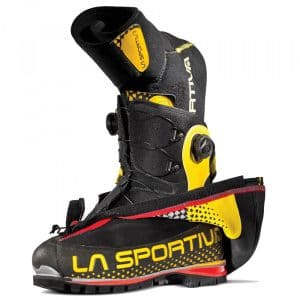
La Sportiva Baruntse
2. I really like the La Sportiva Baruntse mountaineering boots. A lot of our clients and guides have chosen to use these boots. They are great boots for Island peak, Mont Blanc and other Alpine climbs. They are a little bulky and heavier than the La Sportiva G2SM. They have the inner boots which I really like and they are warm and great option for your high altitude mountaineering adventures.

Scarpa Phantom 6000
3. We have a lot of clients using the Scarpa Phantom 6000 mountaineering boots these days. They seem to work very well in a wide range of conditions and are a versatile mountaineering boot that can be used in a wide range of environments. I have however seen some people have issues with the fit of this boot. You really need to make sure you use your boots in your training and break them in. Scarpa can be a narrow fit for a lot of people so make sure you have tried and tested your boots before going on the mountain.

Mammut Norwand
4. We have a lot of people using the Mammut Norwand Mountaineering boots on our Island and Mera peak climbs. These are also a popular boot with clients on our Elbrus and Aconcagua climbs. Although I have not personally used these boots, I have never seen or heard of any have any issues with these mountaineering boots.

FAQ
Q). How much does a visa cost to enter Nepal?
A). Visa entry for Nepal costs USD $50 for a 30 day visa and USD $100 for 90- day visa.
Q). How much is a meal in Kathmandu?
A). An average meal in Kathmandu is approximately USD $10 – $15 per meal.
Q). How much should you tip your guides?
A). The tip given at the end of a trek and climb should be roughly USD $1,200.
Q). Can I leave spare luggage in the Kathmandu hotel while I am on the trek?
A). Yes, the hotel we use in Kathmandu has a luggage storage room for any travel clothes or spare items you want to bring with you to Nepal, but not on trek. We use the Encore by Wyndham hotel in the Thamel district of Kathmandu.
Q). Where do I get water from on a trip?
A). You should use water purification tablets in the 4/5 liters of water you will be drinking each day. Avoiding water borne illness on the trek is imperative! You can buy these in Kathmandu or on the Everest trail. You will want to make sure that you have adequate amounts of water purification tablets with you for the entire expedition. 30 minute treatment is ideal. Check when you purchase.
Q). Is there water at Ama Dablam High Camp?
A). Yes there is water very close to High Camp. We have enough staff and support staff to be able to collect water to boil for you.
Q). Can I buy items on the trail?
A). The higher up the trail you go, the higher the price tags are for items! Anything you want to purchase in the region has to be carried in on the back of a porter or animal, which is why things are more expensive the further they have to travel. Boiled water in Nalgene, for example, is between USD $3 – $5 and this will vary the higher up you go. There are some chocolate bars for sale and other items up to Chuckung and Pangbouche. There is nothing between Pangbouche and Ama Dablam Base Camp.
Q). When is the best time to climb these peaks?
A). This depends on your experience and the experience you are looking to have. Some of our favorite times to be in the region are April into early May and October into November. The monsoon rolls into Nepal in May and stays until September. We like to climb Ama Dablam in October.
Q). When is the climbing season in the Himalayas?
A). There are two distinct climbing seasons in the Himalayas; pre-monsoon (February, March, April and May) and post monsoon (late September, October, November and December). It is not possible to make the journey in January and early September. Our personal favorite is October and November.
Q). When are the peaks a little quieter?
A). The quietest time to visit will be March, early April and late September and November
Q). When is the warmest time to be on these peaks?
A). May and October are usually the warmest times to climb. You never know what the weather will be like in the region.
Q). When is the main climbing season in Mount Everest?
A). The main climbing season on Mount Everest is April and May each year.
Q). What vaccines do I need for Nepal?
A). The recommended follow the CDC guidelines. Vaccines you can consider before trekking to Mount Everest Base Camp include tetanus, Hepatitus A, Hepatitus B, Typhoid, Poliomyelitis, Rabies, Meningoccal Meningitis, Japanese Encephalitis, and the Covid-19 Vaccine.
Q). How do I choose the right lodges for this trip?
A). The accommodation is basic on route to Chuckung and Ama Dablam Base Camp and then we use the same lodges year after year in the Everest region. The lodge owners know us and we know them. This helps us offer you consistency for your trek. We have been building relationships in the region for years.
Reviews
Price
From
$11,500
/ person
Information
Country:
Nepal
Duration:
30 Days
Distance:
90km/ 56m
Max. Altitude:
6,812m / 22,349 feet
Difficulty:
Extremely Challenging/Technical
Group Size:
4 – 6

Ready to go?
Have you built up the correct climbing and mountaineering experience and ready to sign up and take the next step towards achieving your Mountaineering goal of climbing Ama Dablam? If so, get in touch today.
Similar Treks

Island Peak
Overview Island Peak Climbing in Nepal Island Peak, also known as Imja Tse, is one of the best-known 6,000-meter climbing peaks in Nepal’s Everest region. Ian Taylor Trekking...
View more
Climb Himlung Himal (7,126m) | Expert Guided Himalayan Expedition
Overview We are a world leader in running high quality trips to Himlung Himal. Himlung Himal (7,126m) is regarded as one of the best introductory 7,000-meter Himalayan expeditions...
View more

Lobuche Peak
Overview From the summit of Lobuche you have breathtaking panoramic views of the Everest Region. Lobuche Peak is a stunning peak resting at 6,119m/ 20,075 feet above sea...
View more
